
While circadian (24-hour) and seasonal rhythms are well established in human chronobiology, scientific evidence for direct lunar-phase effects on human physiology remains preliminary, mixed, and unconfirmed for clinical decision-making. Throughout this monograph, lunar phases are presented strictly as optional contemplative, journaling, and reflection cues. Lunar phases do not establish a peptide-administration schedule, dosing calendar, or physiological certainty.
Across agricultural traditions, marine observation, and contemplative journals, the roughly 29.5-day lunar month has long served as a visible calendar in the night sky—a recurring reminder to pause, take stock of energy, and notice subtle shifts between action and rest.
Where Chronobiology & Contemplative Tradition Meet
Living organisms organize their physiology around environmental time cues. Daily light-dark cycles govern circadian gene expression, cortisol awakening curves, and nocturnal melatonin secretion, while annual photoperiod shifts influence immune readiness and metabolic patterns across the four seasons.
Beyond daily and seasonal cycles, researchers have also investigated whether monthly lunar phases correlate with subtle changes in human sleep or biological rhythms. Some studies suggest correlations between lunar phases and human sleep patterns—such as observations of slightly lighter sleep or taking longer to fall asleep around the full moon—and chronobiology research examines overlapping circadian, ultradian, and infradian biological rhythms. In agricultural and botanical fields, plant biology studies have likewise examined lunar-phase correlations with plant physiology and traditional cultivation calendars.
These observational associations do not establish a basis for timing medicines or peptides to lunar phases, and no clinical evidence supports timing medications, nutritional supplements, or research peptides to phases of the moon. Honoring both scientific rigor and contemplative tradition means keeping the distinction clear: peer-reviewed chronobiology guides our understanding of sleep hygiene and circadian light exposure, while the lunar cycle offers a poetic, non-prescriptive monthly rhythm for personal journaling and self-observation.
The Four Primary Lunar Phases as Reflection Anchors
When used as a monthly mindfulness calendar—much like a weekly Sunday review or a seasonal solstice check-in—each quarter of the lunar cycle invites a distinct quality of inward attention:
New Moon — Stillness & Intention
Contemplative Theme: Darker skies invite quiet reflection, uncluttered rest, and clarifying personal priorities for the month ahead.
Journaling & Lifestyle Focus: Review your sleep consistency, evening screen boundaries, and baseline energy. Ask what single foundational habit—such as earlier dim light, gentler evening digestion, or unhurried morning hydration—deserves steady attention over the coming weeks.
Waxing Moon — Cultivation & Nourishment
Contemplative Theme: As visible moonlight grows from crescent to first quarter, attention naturally turns toward steady daily craftsmanship and nourishment.
Journaling & Lifestyle Focus: Notice how your body responds to whole-food meals, mineral hydration, and regular movement. Use your field journal to observe whether your daily pace feels sustainable or hurried, adjusting workload and recovery before fatigue accumulates.
Full Moon — Awareness & Sensory Calm
Contemplative Theme: The midpoint of the lunar month represents illumination, harvest, and honest observation of what is working well in your daily routines.
Journaling & Lifestyle Focus: Because brighter evening skies or heightened social activity can sometimes coincide with lighter sleep, prioritize cool, dark sleeping quarters, calming herbal infusions, and slower evening breathwork (Peptides & Meditation).
Waning Moon — Integration & Unburdening
Contemplative Theme: As light recedes toward the close of the cycle, the waning weeks invite simplification, decluttering, and restorative margin.
Journaling & Lifestyle Focus: Reflect on the past three weeks of notes in your Body Wisdom log. Identify unnecessary stressors, overcommitted schedules, or habits that no longer serve your recovery, creating spaciousness before the next month begins.
The Eight Lunar Gates as a Monthly Journaling Cadence
For readers who enjoy finer-grained journaling prompts, traditional almanacs divide the month into eight visual phases. Rather than altering medical care or lifestyle fundamentals, each gate serves as a brief inquiry prompt:
| Lunar Gate | Contemplative Quality | Somatic & Journaling Inquiry |
|---|---|---|
| 1. New Moon | Rest & Orientation | How rested do I feel upon waking without an alarm, and what is my primary intention for wellbeing this month? |
| 2. Waxing Crescent | Gentle Engagement | Which morning and evening routines help my nervous system feel grounded before the workday begins? |
| 3. First Quarter | Steadiness & Adjustment | Where am I encountering friction in meal preparation, hydration, or movement, and how can I simplify? |
| 4. Waxing Gibbous | Refinement & Patience | Am I honoring my body's subtle cues for pacing, or pushing past early signs of muscular or mental fatigue? |
| 5. Full Moon | Clarity & Evening Quiet | What patterns stand out most clearly in my sleep, digestion, and mood halfway through this month? |
| 6. Disseminating (Waning Gibbous) | Gratitude & Digesting Lessons | What supportive insights have I learned about my energy boundaries over the past two weeks? |
| 7. Last Quarter | Editing & Letting Go | Which non-essential commitments or late-night distractions can I release to protect restorative sleep? |
| 8. Balsamic (Dark Moon) | Fallow Stillness | Where can I build extra quiet margin, gentle walks, and unscheduled rest before the new month turns? |
Infradian & Menstrual Cycle Awareness
While the lunar calendar is an external astronomical cycle, many individuals experience an internal infradian rhythm through the menstrual cycle—a biological rhythm governed by hypothalamic-pituitary-ovarian signaling across follicular, ovulatory, luteal, and menstrual phases. Although historical lore often linked menstrual and lunar cycles because of their similar length, human menstrual cycles vary naturally by individual and age and do not require alignment with the moon.
Tracking personal infradian patterns in a journal—noting how appetite, basal body temperature, sleep depth, exercise recovery, and emotional bandwidth shift across the follicular and luteal weeks—cultivates practical interoceptive literacy. Those concrete observations can also make conversations with a qualified healthcare practitioner far more specific and grounded.
Layering Monthly Reflection with the Four Seasons
In the almanac tradition, monthly reflection sits inside the broader arc of the solar year. A New Moon reflection in the crisp stillness of January naturally feels different from a New Moon reflection during the long daylight hours of July:
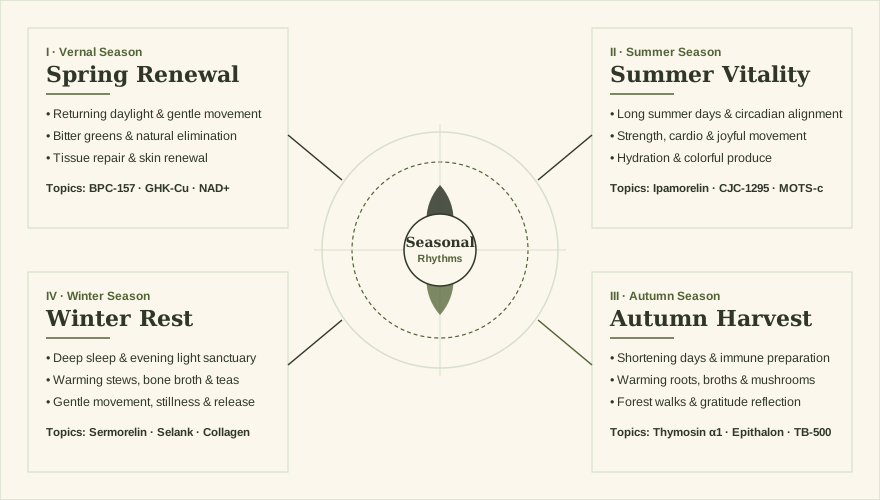
- Spring Renewal: Monthly check-ins focus on digestive lightness, morning outdoor walks, and clearing winter stagnation without rushing into overexertion.
- Summer Vitality: Monthly check-ins emphasize electrolyte and mineral balance, shading the eyes and bedroom from late-evening light, and balancing active days with midday shade.
- Autumn Harvest: Monthly check-ins turn toward warm, cooked root vegetables and broths, mucosal respiratory care, and steadying routines as daylight shortens.
- Winter Rest: Monthly check-ins honor longer nights, earlier evening wind-down rituals, and deep nervous-system restoration.
You never need to track every lunar gate or follow a rigid calendar to care for your physiology. Whether you pause once a month at the New Moon, once a week on a quiet evening, or at the turn of each season, the purpose of an almanac is simple: to create regular moments of honest, compassionate listening to the body you live in.