
Your Body Already Knows: The Science of Interoception
Living within human physiology is a quiet regulatory intelligence—the capacity that coordinates wound repair without conscious instruction, calibrates body temperature, and signals when to rest and when to move. For generations, modern habits have trained people to override these internal cues: masking fatigue with stimulants, ignoring tension until it becomes injury, and treating every physical sensation as an inconvenience.
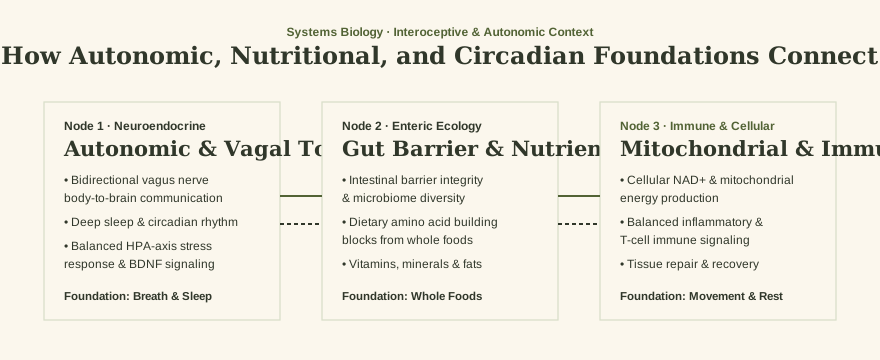
Learning to listen again does not mean abandoning science or replacing medical expertise with guesswork. Rather, research in embodied cognition and mind-body physiology confirms that the body continuously gathers information about its internal environment that informs emotional and cognitive wellbeing. In neuroscience, this internal sensory capacity is called interoception—the sense of the internal physiological state of the body. Just as vision and hearing orient us to the outer world, interoception orients us to heart rhythm, breathing depth, gut comfort, muscular tension, and restorative need.
Five Key Signal Domains in Whole-Person Health
When observing how your body responds to nutrition, sleep habits, movement, or seasonal shifts, five everyday feedback channels offer valuable context:
1. Daily Energy Patterns
Notice how energy unfolds across the day. Steady morning alertness and calm evening tiredness reflect circadian harmony (Sermorelin, Ipamorelin context), whereas feeling "tired but wired" often points to sympathetic stress overload or insufficient nutritional building blocks.
2. Sleep Quality
Sleep is one of the body's clearest messengers. Waking genuinely rested reflects uninterrupted nocturnal repair (Epithalon context), while frequent waking or unrefreshing sleep invites attention to evening light exposure, stress load, and mineral intake.
3. Digestive Comfort
The gut ("the second brain") responds sensitively to stress and dietary quality (BPC-157 context). Observing long-term patterns in appetite, digestion, and post-meal comfort provides far more insight than reacting to a single unusual day.
4. Emotional & Mental Clarity
Because cytokines, hormones, and neurotransmitters converse constantly, shifts in patience, stress resilience, and mental focus (Selank, Semax context) often accompany changes in sleep and physical recovery.
5. Physical Sensations & Tissue Remodeling
In movement and physical recovery (TB-500, GHK-Cu, and Collagen Peptides context), embodied awareness helps distinguish ordinary post-exercise muscular adaptation from sharp, escalating joint or tendon strain that requires rest and clinical evaluation. Research discusses tissue remodeling.
Cultivating Embodied Awareness: Daily Practices
Interoceptive literacy is a skill refined through gentle, non-judgmental attention rather than obsessive self-monitoring:
- Daily Morning Body Check-Ins: Before reaching for a screen upon waking, take a quiet minute to scan from head to toe. Notice how rested you feel, areas of ease or stiffness, and your emotional tone—simply gathering observations without judgment.
- Mindful Movement: Practices such as walking outdoors, yoga, tai chi, or gentle mobility work allow you to notice in real time which movements feel fluid and nourishing and which create strain.
- Meditation, Breathwork & Journaling: Quiet contemplative practices (Peptides & Meditation) reduce mental noise so subtle bodily cues can be noticed. Keeping a simple, qualitative journal of sleep, nutrition, stress, and energy patterns over weeks helps clarify what genuinely supports your wellbeing.
- Seasonal Listening: Notice how your need for warmth, social activity, food density, and sleep duration naturally shifts across Spring Renewal, Summer Vitality, Autumn Harvest, and Winter Rest.
Essential Safeguards: Navigating Challenges & Clinical Boundaries
Honoring body wisdom requires clear humility about what subjective awareness can and cannot do:
- Important Boundary—Not a Diagnostic or Dosing Tool: Subjective bodily sensations, personal journals, intuition, or consumer wearable scores (such as HRV or sleep trackers) cannot diagnose a medical condition and must never be used to select a peptide, determine or adjust a dose, or establish a treatment cycle. Any symptom of persistent pain, swelling, dizziness, mood disturbance, or illness requires evaluation by a licensed healthcare professional.
- Distinguishing Fear From Intuition: Anxious worry often feels contracted, urgent, and catastrophic, whereas grounded bodily awareness feels calm and steady—for instance, recognizing a simple need for sleep, hydration, or a pause from overwork.
- Stepping Back From Information Overload: Endless online reading and comparing your experience against dramatic anecdotes from strangers creates anxiety and disconnects you from your own baseline. Gather reputable educational information mindfully, then step away from screens.
- Building Gradual Trust: If you have spent years pushing past exhaustion, rebuilding trust with your body begins with honoring basic physiological signals: drinking water when thirsty, eating nourishing whole foods when hungry, and resting when fatigued.
Communicating Observations to a Healthcare Practitioner
Scientific research on peptide pathways and physiology provides the objective evidence base, safety parameters, and analytical standards (see our Clean Source Guide), while your lived experience provides personal context. Rather than trying to navigate complex health questions alone, bring your observations—sleep patterns, digestive responses, energy shifts, and questions—to a qualified clinician. Collaborative care works best when objective laboratory testing and clinical expertise meet clear, honest communication about how you actually feel.
Selected Scientific Literature
- Embodied cognition, mind-body interactions, and physiological regulation. PMC. https://www.ncbi.nlm.nih.gov/pmc/articles/PMC6971816/
- Interoception and the sense of the internal physiological state of the body. Frontiers in Psychology. https://www.frontiersin.org/articles/10.3389/fpsyg.2017.00763/full
- Research on tissue remodeling. PMC. https://www.ncbi.nlm.nih.gov/pmc/articles/PMC6566799/
- Molecular signaling frameworks and physiological pathway analysis in peptide research. Scientific Reports (Nature). https://www.nature.com/articles/s41598-021-87533-4